Wednesday, June 8, 2016

"Uncertainty is inevitable at the frontiers of knowledge."


"Uncertainty is inevitable at the frontiers of knowledge."

In the context of the article from which this came from, the author of the article explains that scientists never side with a claim with absolute certainty. This is because even if they feel confident with their experiment, they still feel uncertain. Scientists do not want to declare that something is undeniably true because there is a chance that later on someone else can disprove their hypothesis. For example, a long time ago Ptolemy developed the geocentric theory and it was a widely believed fact that the universe revolved around the earth. Then Copernicus, Kepler, and Galileo came up with the heliocentric theory, in which the earth, the moon, and other planets revolved around the sun. With the newly invented telescope, Galileo had new methods of understanding the composition of space. Scientists even today remain at least a little skeptical of the accuracy of their claims because future knowledge and technology could disprove their claims. Even in chemistry class, when we write labs, we never use the word "prove" because it implies an absolute certainty. Scientists do not want to proclaim an absolute certainty so they will not be completely wrong if someone disproves them later on.

Tuesday, May 24, 2016

“When the only tool you have is a hammer, all problems begin to resemble nails”


“When the only tool you have is a hammer, all problems begin to resemble nails”

I think that this quote refers to how the way that you see things limits what you see. So for example, if sense perception was the "hammer", then that way of knowing would limit the knowledge that a person could obtain through that way of knowing, so the person would only be able to see the "nails". Also, a philosopher named Ludwig Wittgenstein was well known for his philosophy of the limits on sense perception.

“Tell me,” he asked a friend, “why do people always say, it was natural for man to assume that the sun went round the earth rather than that the earth was rotating?” His friend replied, “Well, obviously because it just looks as though the Sun is going round the Earth.” Wittgenstein replied, “Well, what would it have looked like if it had looked as though the Earth was rotating?"

Here Wittgenstein's remark exemplifies the quote with the hammer and nails. Wittgenstein implies that sometimes sense perception can distort the way that we perceive knowledge. The quote with the hammer and nails reflects that ways of knowing, such as sense perception, can change the way we see things.

Thursday, May 19, 2016

Rationalism vs. Empiricism


“There are only two ways in which humankind can produce knowledge: through passive observation or through active experiment.” To what extent do you agree with this statement?

I believe that this statement is accurate because it encompasses all the possible ways to acquire knowledge. The passive observation component refers to acquiring knowledge through unintentional means. The active experiment portion refers to acquiring knowledge intentionally, by manipulating variables. Various ways of knowing (WOK) fall under either active experimentation or passive observation. Language falls under both because language is passed down from generation to generation, which is a form of passive observation. Language is also experimentation because people had to create the words initially, and like Alia mentioned in class, Shakespeare made up words which are part of the English language today. Sense Perception falls under passive observation, because you are not consciously trying to acquire knowledge. Reason falls under active experimentation because you have to manipulate variables in your head when you reason. Emotion can fall under passive observation because it is an involuntary response to a particular situation. Imagination falls under active experimentation because your mind creates imagination consciously. Memory can fall under passive observation because some things are imprinted in your memory unintentionally, but it can also be active experimentation if you purposely try to memorize something. Intuition falls under passive observation because it is unintentional and it is not something that you can manipulate parts of. Faith can fall under passive observation because if someone sees a miracle, it could make them have faith. Some of these WOKs can overlap, even ones I did not mention. But they can all be classified under either of the two categories.

Sunday, May 8, 2016

Ethics Reflection


Do we generally use reason or emotion to make ethical decisions? Which one should we use?

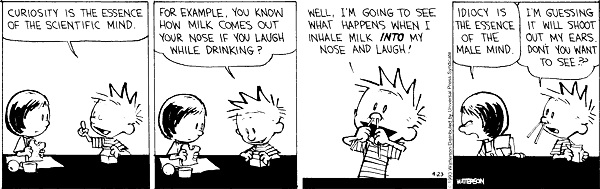
Ethics is defined as "a system of moral principles", or as "the rules of conduct recognized in respect to a particular class of human actions or a particular group, culture, etc". In my opinion, people generally use emotion to make ethical decisions or ethical judgements in general. For example, if I was in the position where it was possible for me to cheat on a test and get away with it (like Calvin in the comic :D), I would decide not to cheat because of the emotions associated with it. For example, I would feel guilt and possibly shame and/or disappointment in myself for cheating.Those emotions would factor in to my ethical decision of whether to cheat or not. People's emotions generally contribute to people's "gut feeling", which then contributes to the ethical decisions that they make. In addition to this, people do use reason to make ethical decisions. However, it is usually used for longer-term decisions. If someone was forced to make an ethical decision on the spot, they would most likely use emotion to make their decisions. But, if someone was allowed to think a particular issue over and then make a decision, they would use reason to make their decision. However, people often make their decision regarding an ethical issue pretty quickly, because their emotions shape their decisions so heavily.

So then which one, reason or emotion should we use to make ethical decisions? I believe that both reason and emotion are needed in order to make the best decision regarding ethics. There are always two sides to issues in ethics. If you only use emotion, then you would not be able to understand both sides of the issue in order to make a calculated decision. Reason can help remove the bias that someone may have regarding an issue due to their emotions. Emotions can skew the way that people perceive an issue, so for example, when we were talking about the prospect of free college tuition. I wholeheartedly supported the side that argued that college should be free. Compassion made me feel that everyone should have the opportunity to have a college education. My stance was almost completely decided on the emotions that I felt regarding the issue. However, as people began discussing the other side of the argument, I realized that I did not even think of reason at all when making my decision on how I felt about the issue. Even though that situation does not completely relate to ethics, it goes to show that emotion can cloud your better judgement when making a decision. However, reason alone should not be used in making ethical decisions. Emotions can put you on the right path to deciding the right thing to do. Making an ethical decision without certain emotions like compassion or kindness could result in making an ethical decision that is harmful to someone. So if your friend came up to you after taking a test and admitted that they had cheated, the right thing to do would be to tell the teacher that they cheated. And while that is the right decision, making the choice without compassion and without thinking of the repercussions of the decision on your friend would be destructive to your friendship.

Sunday, May 1, 2016

Ivory Tower Reflection


What are the three biggest problems facing universities today?

Higher education consists of many problems today that did not exist in previous generations. The biggest and most evident problem facing universities is the issue of cost. Parents have to find a way to pay for their kids' college tuition, room and board, textbooks etc. Colleges are charging an extreme amount of money for their students and this is creating a burden on parents to find a way to support their children's dream schools. Students now are paying triple what students 30 years ago had to pay. This issue will continue to grow until people eventually decide that going to college is not necessary given the price.

Another issue facing universities is the need to prepare students for the workforce. Employers feel that college students lack skills like communication and teamwork skills which are necessary for the workplace. If colleges do not prepare their students for the workplace, employers will favor other employees who may not have a degree.

Colleges are also becoming increasingly obsessed with competition and outdo-ing each other. Universities are vying for the top positions in various rankings. They build extravagant facilities at their campuses that also contribute to the issue of affordability as students have to pay more in their fees to accommodate for those new facilities.

Monday, April 25, 2016

Monday, April 18, 2016

Economics


Is economics a science?

To determine what constitutes a field of knowledge as being a science, the definition of a "science" should be established. According to the Science Council, science is: " the pursuit and application of knowledge and understanding of the natural and social world following a systematic methodology based on evidence."

http://sciencecouncil.org/about-us/our-definition-of-science/

A key point to what a "science" denotes is that it is a so-called "empirical field" which means that it is based off of observations and evidence.Economics therefore is a science. It uses observations and evidence to create knowledge. Economists use observations such as measuring variables such as prices and market size. Economists use evidence such as sales or stock. Though economists may not be able to conduct experiments in the same way that subjects like biology and chemistry do, by directly altering a certain variable, economics is a science.

Tuesday, March 15, 2016

Emotion


To what extent does emotion clarify knowledge in the arts?


Art is almost completely shaped by emotion. Many types of music are intended to move us and stir our emotions. For example think of Adele's (amazing) hit song "Hello". For most people this song stirs intense feelings and leaves them feeling melodramatic and a little overemotional. Now look at songs like "Thriller" and "Billie Jean" by Michael Jackson. These songs fill people with the desire to dance, because they are such upbeat songs. The way we feel about the songs shapes the way we clarify knowledge for arts. In another instance, I was doing homework while listening to the TV, which happened to be on The Voice at the time. I was not really paying attention to the TV, but I was just keeping it for the sake of background noise. Well at the time, there were two singers who were singing a duet together and they sounded so amazing together that I just had goosebumps and I was amazed at the notes that they were hitting. I was legitimately moved by the music. The arts are meant to appeal to emotions and invoke specific feelings in people. Sometimes you may not even know why you feel a certain way when you hear a song, or see a picture, etc, because art influences emotion in such a unique way.

Sunday, March 6, 2016

Sense Perception


To what extent does culture influence perception and/or reason?

When people are born and brought up in a certain society, they are inevitably shaped by cultural traditions and norms which in turn influence people's perception of their surroundings. For example, even though I was not born in Sri Lanka, like both my parents were, I was brought up with the same cultural traditions and customs that I would have had in Sri Lanka. Sri Lankan culture has definitely influenced my perception, especially regarding respect. In Sri Lankan culture, it is expected that you have a deep respect for your elders. When my parents came to the US, they thought that all the young people they met were disrespectful, when really they were just not brought up with the same cultural traditions and norms that my parents were.

Also, in Shotokan Karate, we are expected to follow the traditions and customs of Japan. So for example, it is considered very rude to sit with the soles of your feet pointing an elder person. I also read an article a while ago about the different manners that cultures around the world had. For example, in Germany and Kenya, you are expected to finish all the food on your plate, otherwise the host will feel insulted because they will think that you did not like their meal. People in different cultures have various perceptions on many things, especially on respect.

Article link: http://www.oh-i-see.com/blog/2013/11/11/20-cultural-dos-and-taboos-manners-around-the-word/

Sunday, February 28, 2016

Language


Should words have just one meaning or more than one meaning?

I think that words should not have just one meaning. Part of the beauty of language is that words can be interpreted in different ways. For example in Latin, there are multiple ways to interpret a single line of poetry. While it may create some confusion for those who listen to/read it, the multiple meanings of words can make language apply to a large range of areas. A language with many meanings for a single word reflects the differing experiences that people have regarding that word. The counter-argument would be that it would be much more efficient to have one meaning for each word to avoid confusion. However I would argue that language would be very outdated as well as lifeless and stagnant if each word had a single meaning. Language is dynamic; meanings for words change as different connotations for them arise. I would also argue that the main purpose of language is to communicate and express feelings or emotions. Forcing a single meaning to each word would make it much harder for people to show their exact feelings or to communicate what they wanted to. Language creates a way to convey a personal style by using different words with different connotations. A good comparison would be how poetry can articulate some emotions and feelings that regular prose cannot. Reducing language to a single meaning for each word would eliminate a crucial aspect of language: individual expression.

Sunday, February 21, 2016

Justified True Belief


Are there reasons to be skeptical of your knowledge claims?

I think that it is good to be skeptical of your own knowledge claims. Skepticism maintains an open-mind, which paves the way to possibly uncovering a deeper truth. I read an article several months ago in which it detailed how the human mind was originally wired to believe what it heard. The mind was meant to believe what it wanted to believe and what it already believed. However the human mind began to change to be skeptical and question common claims. Skepticism is beneficial but only to the right degree. For example, someone who is too skeptical would be stuck in a bubble, unable to believe or trust anything. Conversely, someone who is not skeptical at all would be used by other people because they were too gullible. A moderate level of skepticism would be someone who has an open mind, but questions certain things. If no one was skeptical, everyone would believe what they were told and people would accept possible discrepancies in common knowledge.

Wednesday, February 17, 2016

The Allegory of the Cave


Questions:

  1. In the story, the man has to adjust to the new light that he sees, since he is so used to being in the dark. Do you think that people would not want to adjust to the light and not even leave the cave, even if they had the chance?
  2. Do you think it would be possible to persuade the people still in the cave to come out or will they always want to remain in the cave?
  3. How does society shape the way we perceive light and darkness?